

One question that comes up very often, when talking about atomic clocks, is what performance do different types of atomic clocks have and how do they compare to each other. If you look for this question, you will find several answers, but most of them will be either from 10 or even 20 years ago or cover only a single type.
Thus I collected data from some representative samples of atomic clocks and put
them all together in a single Allan deviation graph
with a short explanation of each atomic clock:
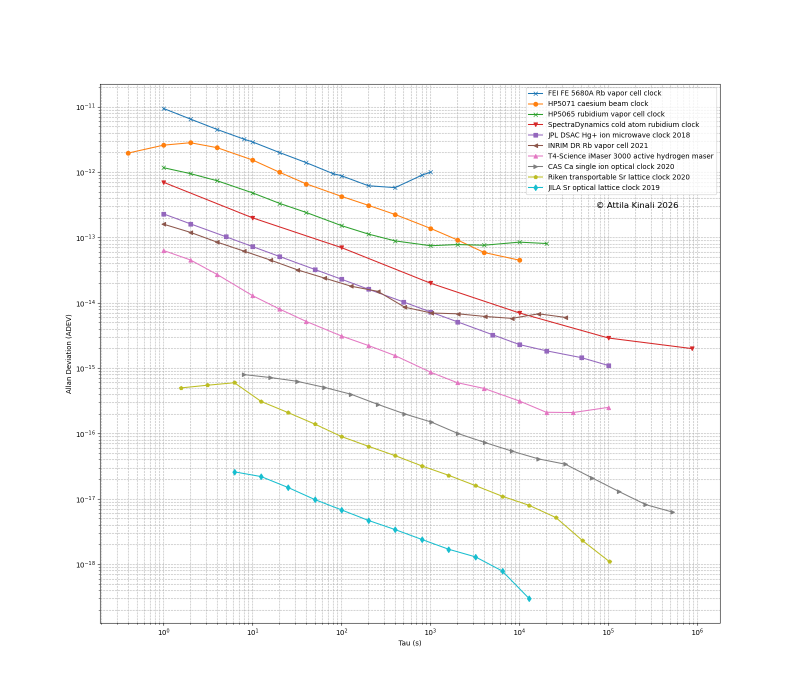
Starting at the top, we have an FEI FE-5680A rubidium vapor cell standard (Data from John Miles). These, although are not sold anymore, are representative of what commercial, “telecom grade” rubidium vapor cell standards achieve. A noteworthy feature of all vapor cell based clocks, and this includes two-photon absorption optical clocks, is the Allan deviation going up again, due to frequency drift. The two main contributors to this drift are changes in the light intensity of the rubidium lamp in classical lamp pumped standards and temperature related shifts.
Next we have the venerable HP 5071A caesium beam standard (Data from Tom van Baak) developed in the late 1980s, early 1990s and the successor to the HP 5061. It is the most widely used caesium beam standard and still produced pretty much without change (the recent update to 5071B by Microchip is only an adaption to RoHS and to replace obsolete components, otherwise there are no changes). Many regard this as a primary frequency reference, as it uses caesium upon which the current definition of the second is based. But, at least for metrological purposes, the accuracy of just 5e-13 is not good enough. Many national metrological institutes use the HP5071 as their fly-wheel standard, due to its very good stability of better than 1e-14 for times larger than a day, and correct the frequency offset of the HP5071 once a month, either using the BIPM’s Circular T or by running their own primary frequency standard, which can be a caesium beam standard itself (e.g., CS1 and CS2 at PTB) or a caesium fountain clock.
The HP 5065 (Data from Tom van Baak) another HP classic. These are pretty much the epitome of lamp pumped rubidium vapor cell standards. Their short-term and medium-term performance is very good, especially considering their age. As they have not been produced for a long time and there have not been many to begin with, they are very rare these days and if you can get your hands on one, they are expensive. But if you can get your hands on one, and couple it with a GPSDO, you get one of the best frequency standards for home use.
Now we come to modern frequency standards, with the SpectraDynamics cRb (Data taken from the datasheet) a cold atom rubidium clock. It works by collecting rubidium atoms in a variant of a magneto-optical trap using isotropic laser cooling. When enough atoms have been collected, they are dropped through the interrogation and detection chamber. Because a large number of atoms are collected and all have a very low temperature (in the mK range), the short-term instability drops now below 1e-12 @ 1s. And because this process is very repeatable, the long-term performance hovers just slightly above 1e-15. While this is a rubidium based clock, it should not be confused with vapor cell clocks. The cRb has no drift behaviour and its Allan deviation stays completely flat at <3e-15. If you were looking for a passive hydrogen maser and cannot find one anymore (the only manufacturer of passive hydrogen masers is Russian), then the cRb is your replacement. And as a bonus, you get a clock without drift.
Our first non-commercial clock is the JPL Deep Space Atomic Clock (DSAC) (Data taken from their paper). This is a ion microwave clock, meaning, mercury ions are held in place in a linear RF-trap, also known as Paul trap. The low pressure (4e-4 Pa) helium or neon buffer gas cools the atoms down to a few 100°C and thus gives a benign environment to talk to the atoms. The combination of a large number of atoms (1e7) and a very good local oscillator enable a very impressive short-term performance. While this clock uses a buffer gas just like the vapor cell clocks, the pressure is orders of magnitude lower, thus any pressure shift is orders of magnitude lower (the size of the shift is approximately linear in a lot of cases), thus there is only a very small drift (estimated to be 3e-16 per day for this particular one). JPL has built more lab size variants of the mercury ion clock, which have even better performance, but because mercury ion clocks require long interrogation times (10s to 100s of seconds) to achieve their full potential, they have used active hydrogen masers as their local oscillator. While this is an absolutely valid way to build an atomic clock (and not the only example I know of), for the purpose of this comparison, it is a little bit cheating, as the short to medium-term performance is dominated by the performance of the hydrogen maser. Unfortunately, most of the available data that uses a crystal oscillator as local oscillator does not show the long-term performance well enough to be useful for this comparison.
Next comes our second research atomic clock, a laser pumped rubidium vapor cell clock by INRIM (Data taken from their excellent paper). This is probably as far as rubidium vapor cell frequency standards can go. The group at INRIM has identified and removed/mitigated every source of instability and drift (temperature, pressure, laser frequency and intensity, …) and built, as far as I am aware of, the best rubidium vapor cell clock to date. Their short term performance is fabulous and they have gotten the flicker frequency floor down to below 1e-14. But, as with all vapor cell clocks, their long-term performance is limited by the vapor cell, which results in long-term frequency drift. Because of the superb stability of the clock, this drift is only visible for longer measurements, beyond a day, for which the published measurement is too short. The whole path to getting to this performance is documented in their publications over the past 20 years. Just search for Salvatore Micalizio, Claudio E. Calosso, and Filippo Levi. And while you are at it, also look for Gaetano Mileti and Christoph Affolderbach. The two groups at University of Neuchâtel and INRIM cover probably 90% of what we know about rubidium vapor cell atomic clocks.
The T4 Science (now part of Safran) iMaser 3000 (Data taken from their website) is a state of the art example of an active hydrogen maser, with, for a hydrogen maser, exceptionally low drift, beating its direct competitor, the Microchip MHM-2020 by quite a bit. Unlike all previous (and all later) atomic clocks, an active hydrogen maser is, as the name implies, an active atomic clock. I.e. instead of irradiating the atom with a signal and looking for a response (fluorescence, absorption, etc) as is done in passive atomic clocks, active atomic clocks let the atoms themselves emit the signal. Even though the emitted power is very low (a few pW), this allows for superior short-term performance. (There is research going on to achieve the same active regime with optical clocks, called superradiant clocks, see e.g. this summary paper by Martina Matsuko and Marion Delehaye, but nobody could demonstrate a working active optical clock yet). The long term drift is dominated by two factors, the cavity pulling and wall collision shift. Cavity pulling is changes in the resonant frequency of the cavity due to minute changes in length, either because of temperature change of mechanical relaxation of the material, which slightly shifts where the peak of the atomic signal is seen. Wall collision shift is the interaction of the hydrogen atoms with the walls of the glass bulb that keeps them centered in the cavity. Each of these collisions affect the electrons ever so slightly and thus change their effective energy levels. Wall collision shift is minimized by the use of the right wall coating (PTFE) and cavity pulling is mitigated by an automatic tuning scheme that electronically changes the cavity’s resonance frequency to match that of the atoms. Active hydrogen masers have been our most stable atomic clocks (for short and medium-term) for decades (only cryogenic sapphire oscillators are more stable, but only short-term) and they are not atomic clocks) and thus have been the workhorse of many national metrological institutes around the world, for time keeping, often combined with the aforementioned HP5071 or a caesium fountain for removing long-term drift.
And this brings us to the current contenders for the top position of atomic clocks: the optical atomic clocks.
Very much simplified, there are two things that define how stable an atomic clock is: the quality factor and the signal to noise ratio (SNR). The SNR measures how much the signal sticks out of the noise. The noise is mostly the noise from the detection electronics (another simplification). Which means, to get better SNR, the only way is to increase the signal. And the way to increase the signal is to increase the number of atoms interrogated. The quality factor, in the context of atomic clocks, is the ratio between the frequency of a transition and how wide or blurry the transition is. For physical reasons, the width of the transition is pretty constant for most atoms and transitions (given they are undisturbed, free flying in vacuum). Which means, the best way to increase the quality factor is to increase the frequency. So, we want as high a frequency and as many atoms as possible. The invention of the optical frequency comb 20 years ago has enabled us to relate optical frequencies down to microwave frequencies and thus to precisely and accurately measure them with very low noise. Which in turn enables us to use optical transitions in atoms to build atomic clocks which are in the range of 100 to 400THz instead of the 1.4 to 40GHz of the hyperfine transitions used in the atomic clocks mentioned above, a factor of 3000 to 300'000 higher.
There are roughly two classes of optical atomic clocks: the ion clocks and the neutral atom or optical lattice clocks. The former uses an ion trap to hold one or more ions in place, similar to the JPL DSAC mentioned above. In particular the single ion optical clocks are regarded as the most accurate clocks, as a single ion can be held with very little disturbance. The team at University of Colorado have built an aluminium ion clock that reached a systematic uncertainty below 1e-18, two orders of magnitude below what the best caesium fountains achieve! Unfortunately, because it uses only a single atom, it’s short-term stability is rather low (for an optical atomic clock) with “just” 1.2e-15/√τ. The optical lattice clocks trap 1000s to 10'000s of neutral atoms within a standing field of a laser, holding them in place. This much larger number of atoms allows to achieve a much better short and medium-term performance. But this comes at a cost: the strong laser that is required to hold the atoms, disturbs the atoms electrons and thus the energy levels. Thus, while they achieve almost two orders of magnitude better short-term stability, their uncertainty is often an order of magnitude worse.
The first optical clock on the list is a single calcium ion clock from the Wuhan Institute of Physics and Mathematics, part of the Chinese Academy of Sciences (Data taken from their most recent paper). This is not the best performing single ion clock, but one that runs for long times uninterrupted. Their achievement of almost 40 days of uninterrupted operation of two atomic clocks of the same type led to a very nice stability evaluation.
The second is transportable strontium lattice clock from RIKEN in Japan, who used them a few years ago to test general relativity by placing one clock high up at the SkyTree tower in Tokyo and one at its foot (Data taken from the supplemental material of above paper). This shows what kind of performance optical lattice clocks can achieve outside of well controlled laboratory environments. Which is more than one order of magnitude better than the best active hydrogen maser, which was likely placed in a quiet laboratory with perfect temperature control.
The third optical clock is, again a strontium optical lattice clock, this time from JILA (Data taken from this paper). This is what can be currently achieved in terms of atomic clocks, both in terms of stability and uncertainty, the latter of which is superb for an optical lattice clock with just 2e-18.
This concludes our list of atomic clocks, covering almost six orders of magnitude in terms of stability. I am sure that we will still see more improvement in the performance of optical atomic clocks. And there is also the prospect of a thorium based nuclear clock which promises even higher accuracy.
I would like to thank Tom van Baak, John Miles, Claudio Calosso and Christoph Affolderbach. The former two for providing measurement data of commercial clocks and the latter two for many discussions and explanations on what makes a performant atomic clock.